We combined early and new optical light curves of the doubly-imaged quasar FBQ 0951+2635 to robustly measure a delay of 13.5 ± 1.6 d (1σ interval). This new time-delay interval and a relatively rich set of further observational constraints allowed us to discuss the mass structure of the main lensing galaxy at a redshift of 0.26. When modelling the galaxy as a singular power-law ellipsoid without hypotheses or priors on the power-law index, ellipticity, and position angle, we demonstrated that its mass profile is close to isothermal, and there is a good agreement between the shape of the mass distribution and that of the near-IR light. We also found that a constant mass-to-light ratio model works acceptably well (see paper).
We developed easy-to-use Python scripts to estimate the time delay of a multiple-image quasar with two different methods incorporating polynomial microlensing variability. These scripts are publicly available at GitHub.
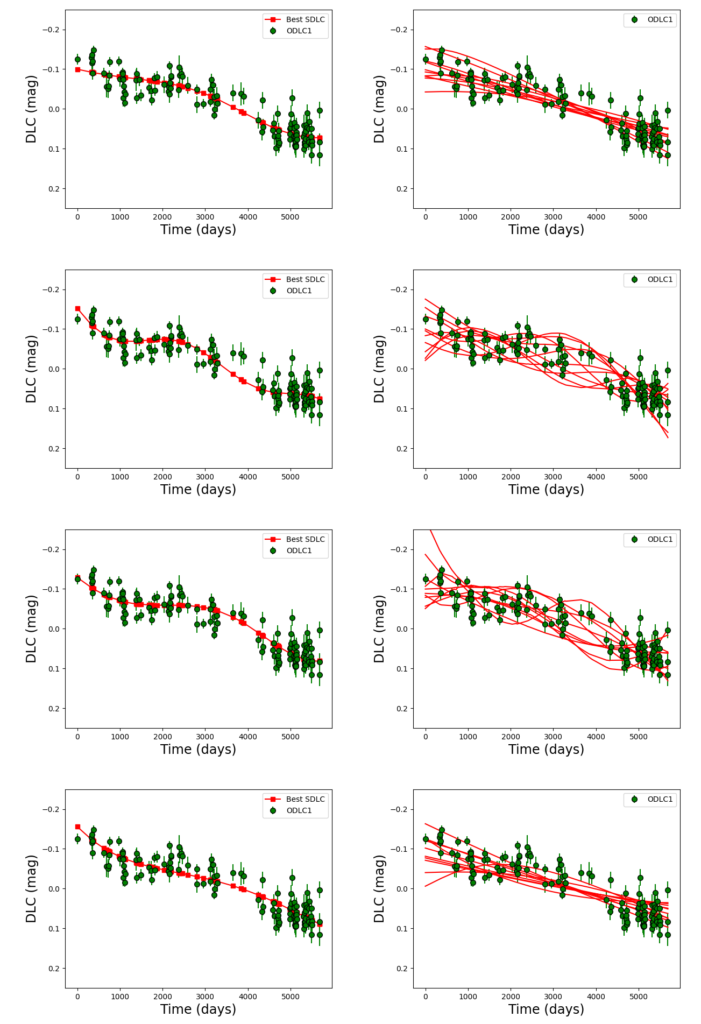
In a subsequent paper, we focused on the main lensing galaxy for probing possible populations of primordial black holes (PBHs), since dark matter in galaxies may consist of PBHs formed soon after the initial Big Bang. Assuming that the mass of the galaxy is due to smoothly distributed matter (SDM), stars, and PBHs, 16-yr microlensing variability observations were compared in detail with simulated microlensing signals generated by 90 different physical scenarios. While none of the scenarios considered can reproduce the overall observed signal, the observed long-term variability favours a small mass fraction in PBHs with a mass of the order of the mean stellar mass. Furthermore, it is possible to obtain strong constraints on the galaxy mass fraction in Jupiter-mass PBHs, provided that a reverberation-based measurement of the source size is available and relatively small. To constrain the mass fraction in ∼10 M⊙ PBHs, light curves five times longer are probably required.