We conducted a long-term optical monitoring of the doubly-imaged gravitationally lensed quasar SDSS J1001+5027 consisting of spectrophotometric observations separated by Δt ∼120 days (time delay between both quasar images) and test/auxiliary data. This monitoring approach allowed us to reliably find a strong microlensing-induced chromatic variation of the quasar continuum in the period
2022−2025. The ongoing microlensing event has caused a dramatic changing-look of the delay-corrected spectral flux ratio in 2025 (see paper). The current status of this flux ratio is being tested through observations with the Liverpool Telescope in January and May 2026.
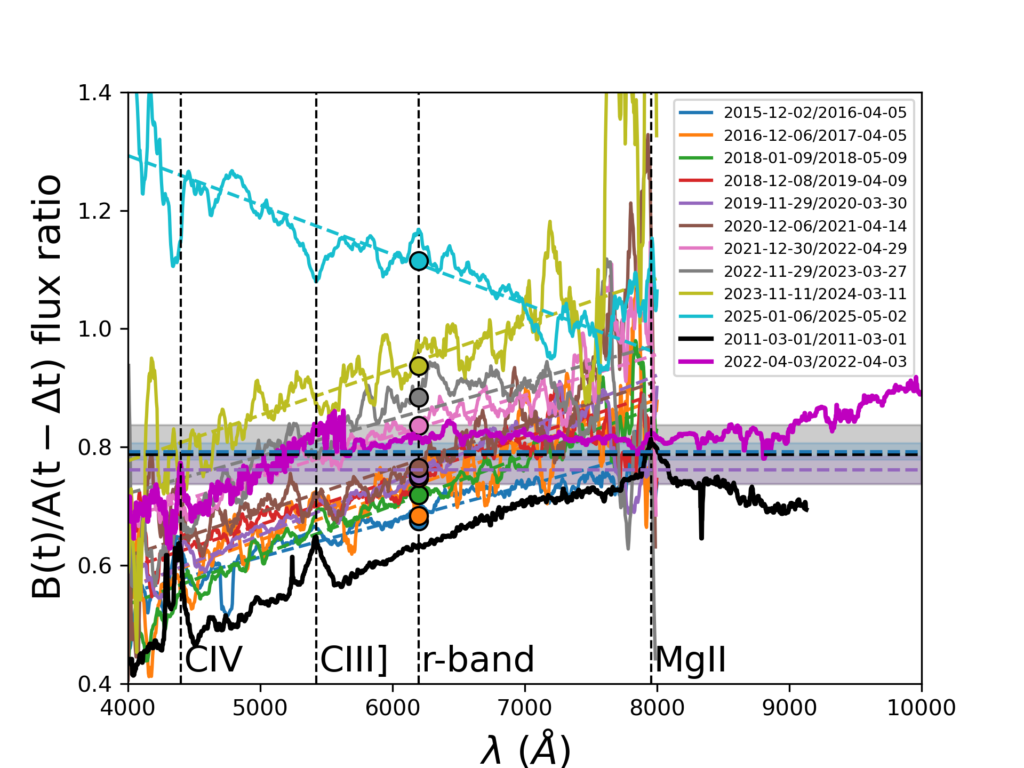
spectral flux ratio from Gemini North/GMOS (black line) and Keck/LRIS (deep purple line). The three horizontal strips correspond to the Civ (purple), Ciii] (blue), and K-band (grey) flux ratios, which are used to highlight the macrolens flux ratio.