We present an optical monitoring of the quadruply-imaged gravitationally lensed quasar QSO 2237+0305, the Einstein Cross, including observations from three different observatories in both hemispheres and using a new photometric technique (see paper). This technique uses a region far enough from the lens system to accurately determine the sky background level and minimises contamination from the lensing galaxy by combining analytical and numerical modelling of its structure. The resulting light curves of the four quasar images describe variations across practically the entire optical spectrum and span about 9000 days in the VRI bands (see figures below).
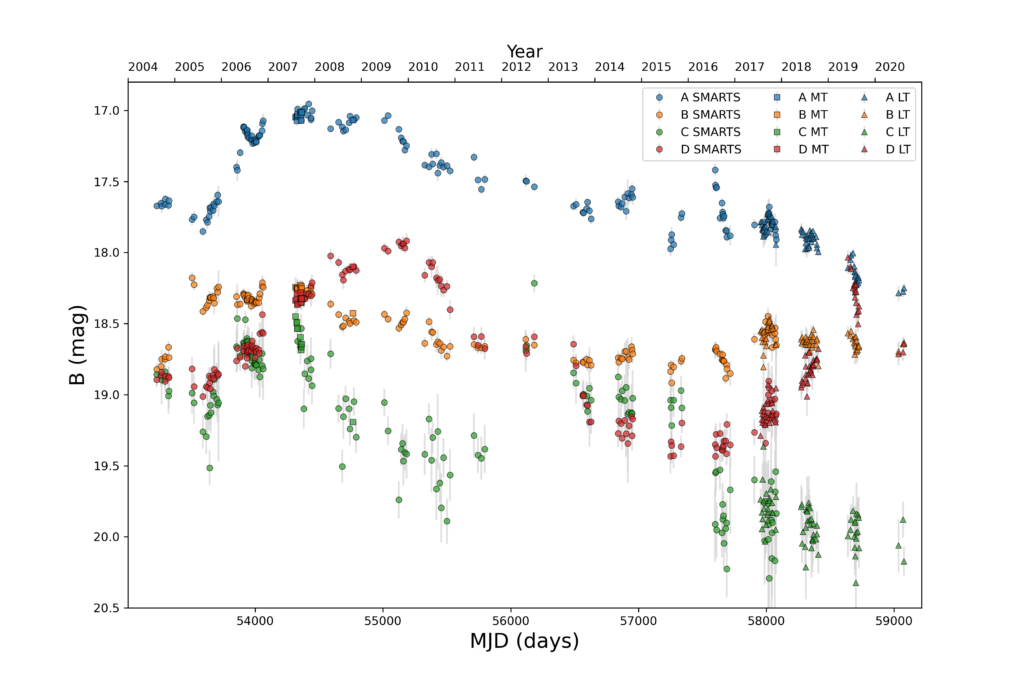
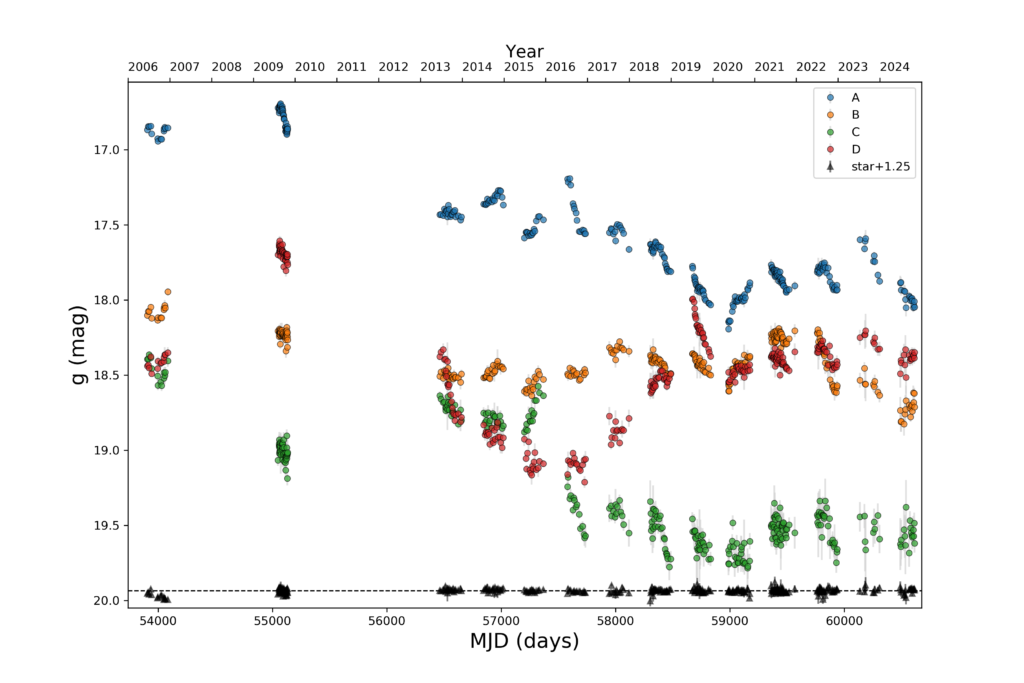
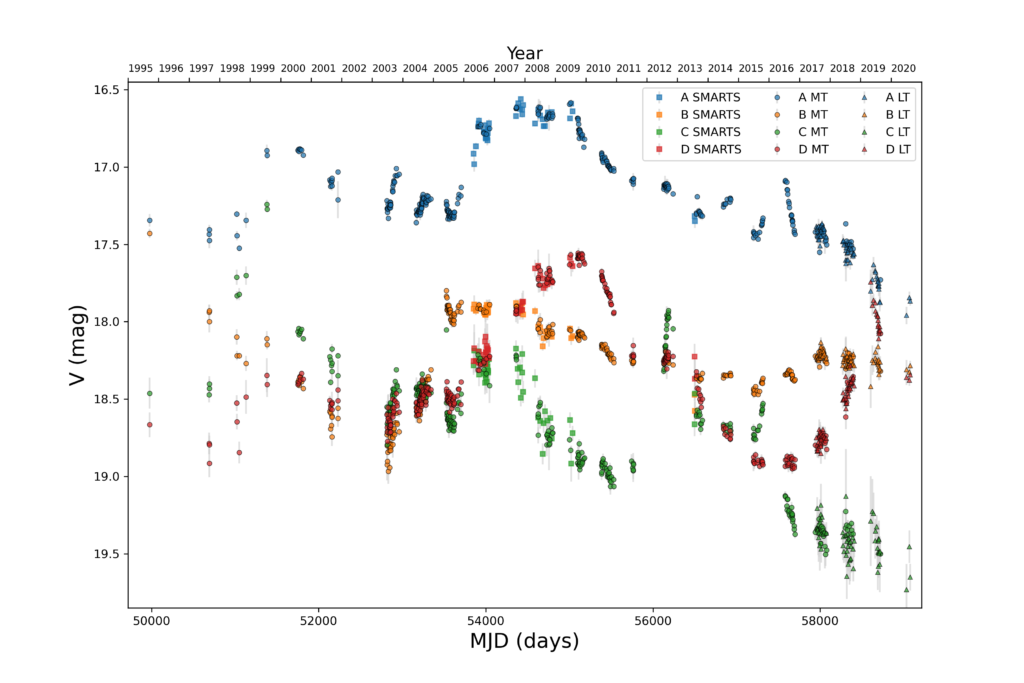
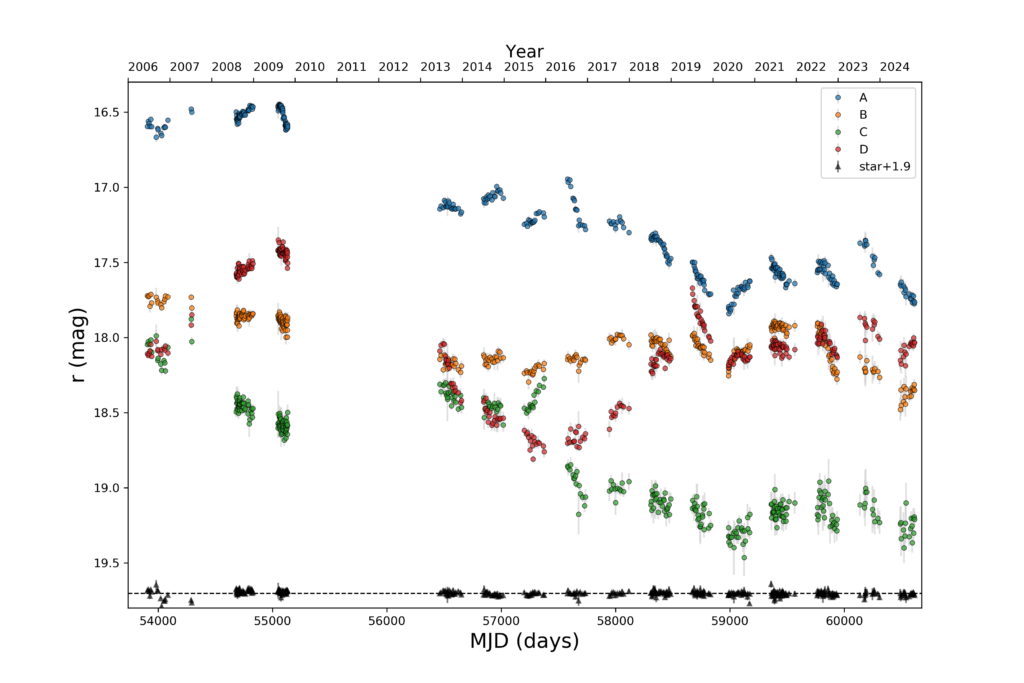
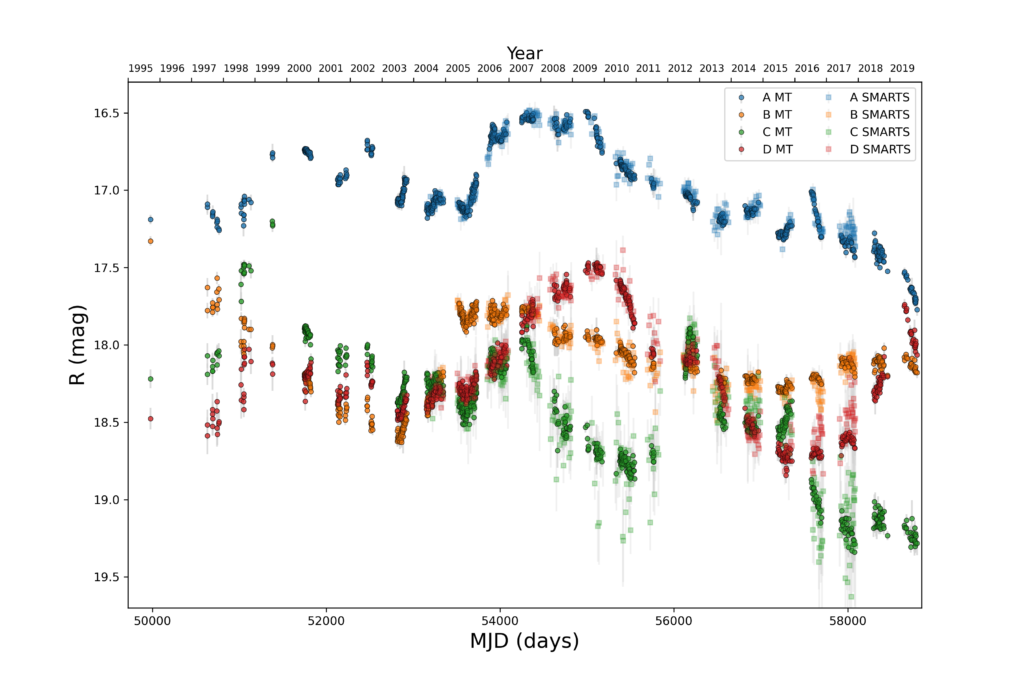
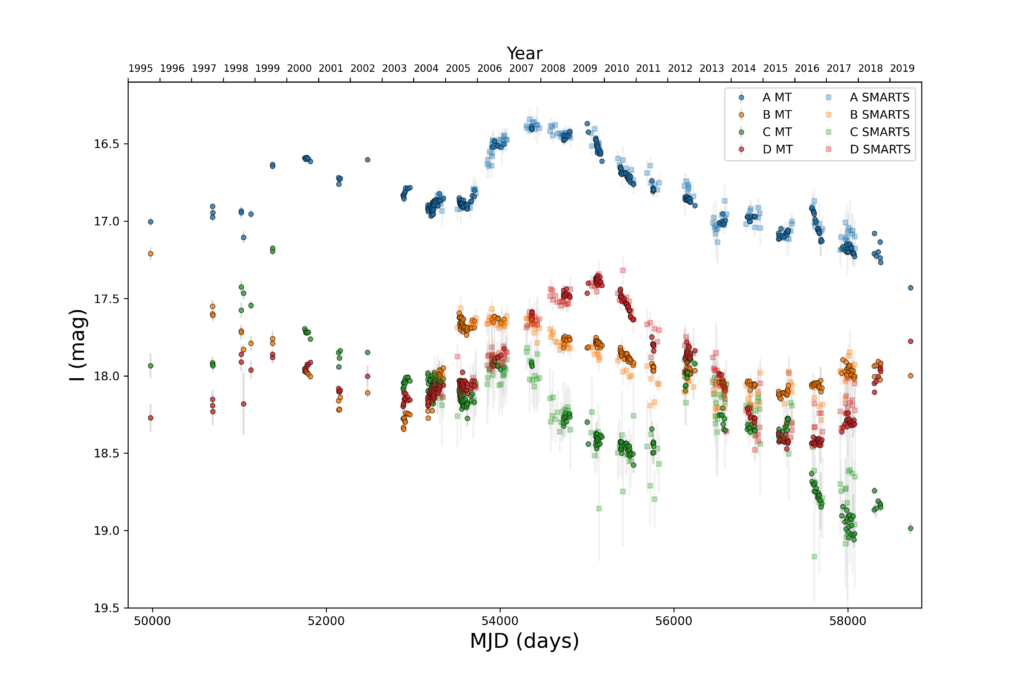
A preliminary microlensing analysis reveals an almost linear scaling of the source radius with wavelength, providing direct evidence for the wavelength-dependent structure of the region contributing to optical passband fluxes. To account for random motions of stars, we create
dynamic maps (animated sequences of static magnification patterns) that we call magnification cubes (see below). Assuming a mean microlens mass ⟨M⟩ = 0.3 M⊙ and concentric Gaussian sources that move according to the velocity distribution peaks (speed and direction) reported in a previous microlensing analysis, we find that the half-light radius of the g-band source is 9.6 ± 2.7 lt-day and the size of the sources grows with wavelength with a power-law index of α = 0.94 ± 0.05. This slope is shallower than the standard disc model at ∼8σ significance. Even assuming a possible underestimation of the error in α by a factor of two or three, there are serious difficulties for a standard accretion disc as the sole source of UV-optical continuum radiation in QSO 2237+0305. Although a non-standard accretion disc model can reproduce the observations, optical passband fluxes come from the central accretion disc and the broad emission-line region, so the measured relationship between source size and wavelength could be considerably flattened if the contribution of the extended region is substantial.